Talks, essays, arts review and interviews
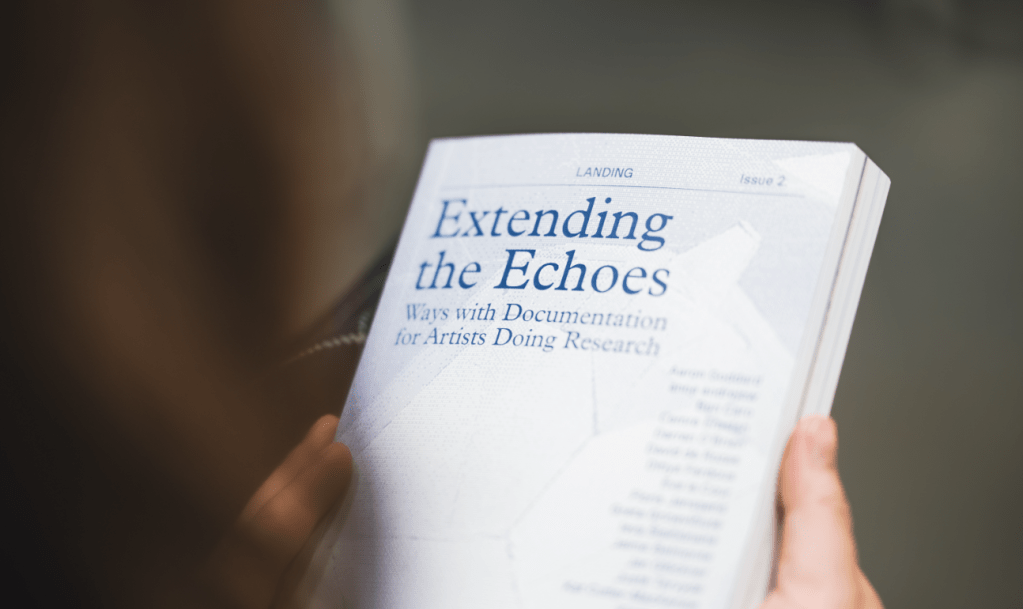
Essay: Two Movements in Diasporic Anthropophagy (2025)
Published by the peer-reviewed journal Landings by the University of Vilnius, Lithuania.
This article discusses two arts-based interventions undertaken as part of a year-long inquiry on South Asian diasporic subjectivity. Using a methodology comprising both phenomenological and arts-based research processes, I detail the practical and qualitative aspects of the research leading to new understandings on the subject-matter. The framing of ‘diasporic anthropophagy’ alludes to the Brazilian Anthropophagic Movement, which has inspired my intention for the inquiry to symbolically cannibalise the narratives of the South Indian diaspora in an effort to surface an authentic diasporic subjectivity. The key references to Indian culture regard mudras in the Bharatanatyam dance form and the story of Sita’s burial into the Earth in the Ramayana. Phenomenological concepts of felt sense, content-in-process, and intersubjective response were key to my inquiry and are discussed as per the teachings of the Melbourne Institute of Experiential and Creative Art Therapy.
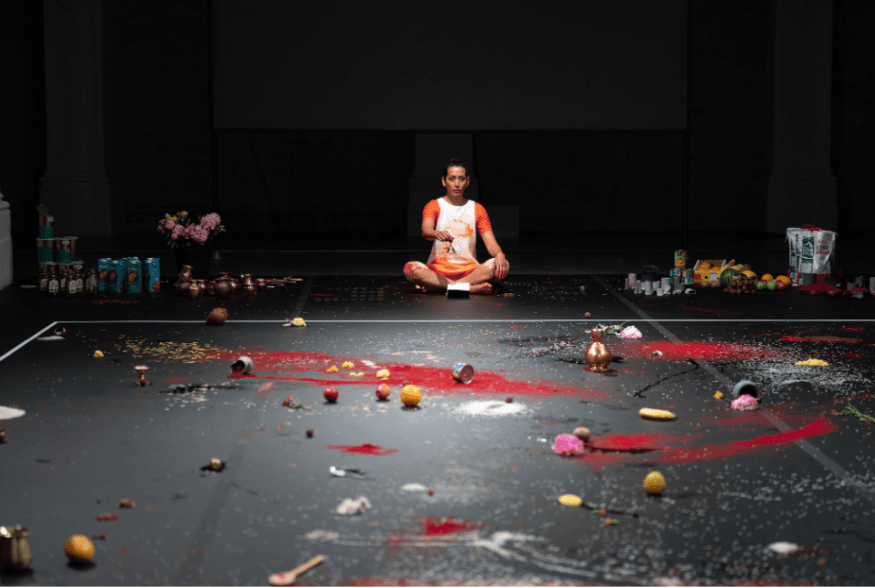
Review: Offerings, Devika Bilimoria at Whitechapel Gallery, London (2025)
Published by Performance Review. Image credit: Devika Bilimoria 2025.
Review excerpt: “In South Asian religious traditions, the act of offering to the gods is a rite to be performed first and foremost by a priest. It is these holy men who instruct families on the divine duties bequeathed upon their caste or clan, petering sacred conventions down generations who disperse them across their migratory offspring and household conventions: the way a parent or grandparent anoints an idol, the assembly of an altar or the precision of a prostration. Yet, for many diasporic generations, these acts and our relevance within them, are never wholly demystified in relation to the central figure of the godhead.
It is this absence that Offerings speaks to, suggesting an alternate semiotics through which to engage in a dialogue with sanctity. Inhabiting the role of both priest and benefactor and displacing biases of caste, gender and familial rites, Bilimoria usurps orthodox hierarchies and reappropriates the templates of ritual.”
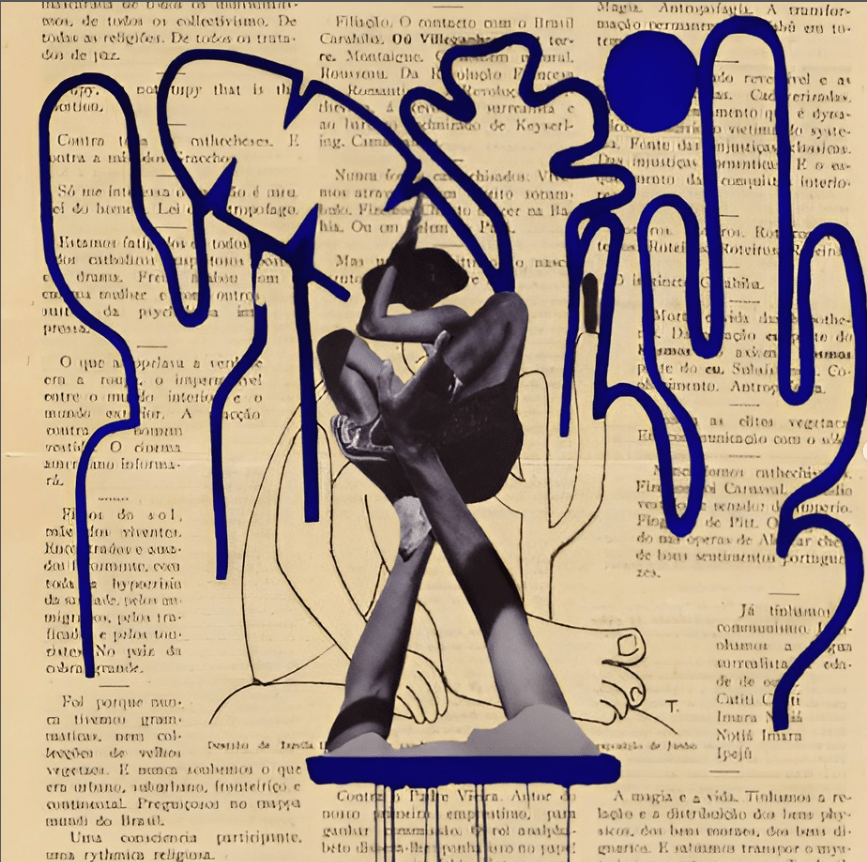
Talk: Eat Your Head, Towards a Diasporic Anthropophagy (2025)
Presented at Seventh Gallery, Melbourne Australia.
“This talk examines the intersections of diasporic inheritance, kinopolitics, and the philosophical provocation of cultural cannibalism, as theorised by poet Oswald de Andrade and painter Tarsila do Amaral within the Brazilian Anthropophagic Movement.
Through a reflexive engagement with archival materials and artistic interventions, Nithya interrogates the socio-cultural symbols and narratives that shape the South Indian diasporic body. Her research extends the revolutionary imperative to “cannibalise the coloniser” towards a radical form of symbolic self-cannibalism – one that transgresses internalised hegemonies and invites encounters with alterity through an embodied return to the past.
This event will take the form of a presentation where Nithya will discuss key theoretical contributions of the Anthropophagic Movement within a contemporary diasporic framework. She will share excerpts from her research findings, offering insights into the aesthetic and political stakes of her practice.”
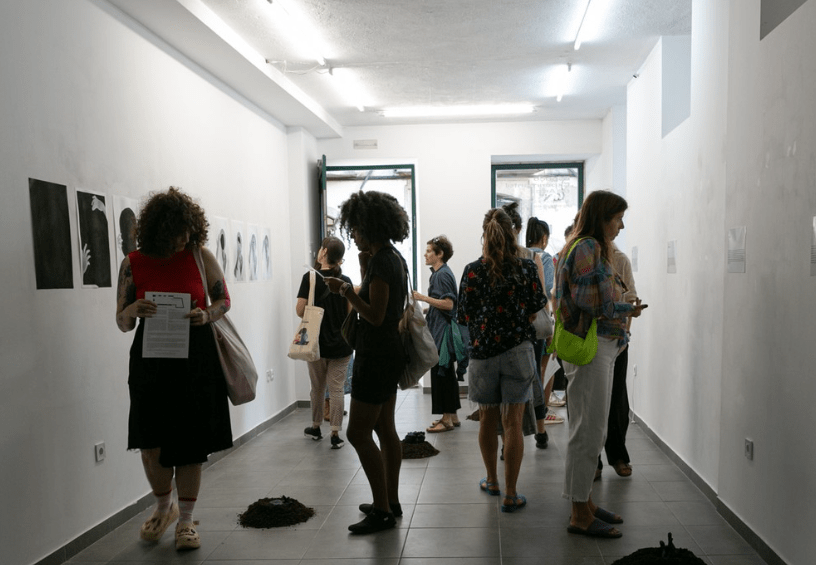
Exhibition Talk: Of Her I Know Only (2023)
Presented at NowHere, Lisboa, Portugal, curated by Cristiana Tejo, alongside a solo exhibition.
A talk that explores the artistic inquiry of the exhibiton works, explaining the images, ideas and processes used in the works and how they have been interpreted to apply the principles of the Brazilian Anthropophagic Movement to notions of South Asian feminism. This talk also references concepts and theories in territorialisation and deterritorialisation inform in relation to embodied feminist practices.
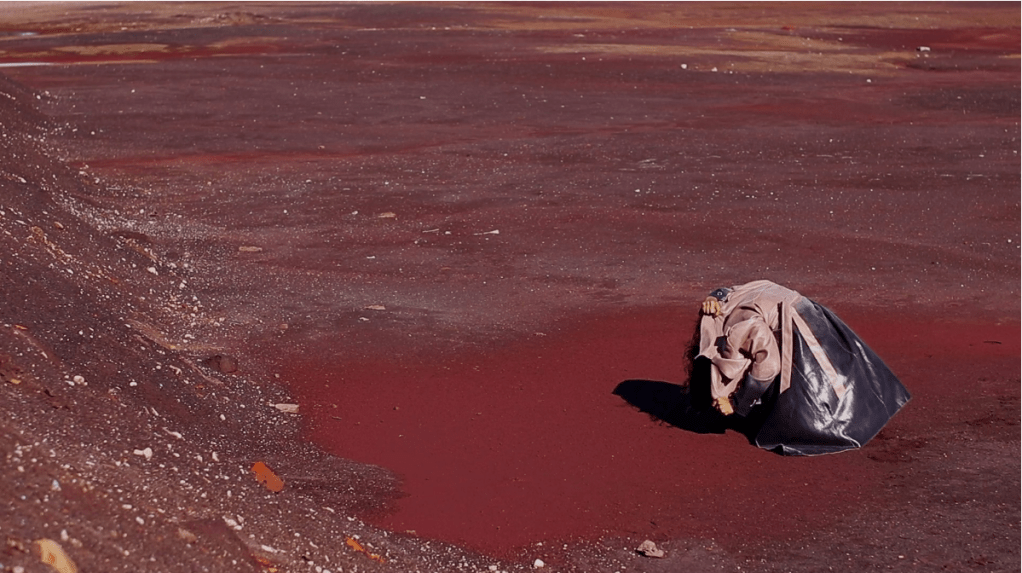
Talk: The Body as Interval, with The Third Thing (2022)
Moderated by Sarah Lewis-Cappellari for PADA x Sluice TERRITORY Expo, Barreiro, Portugal.
How ideology is petrified in spatial territories and the potentialities of the body in negotiating alterity through reflexive and improvisational encounters. A conversation between Nithya Iyer + Vlad Mizikov (The Third Thing) and Dr Sarah Lewis Cappalleri UCLA PhD (c).
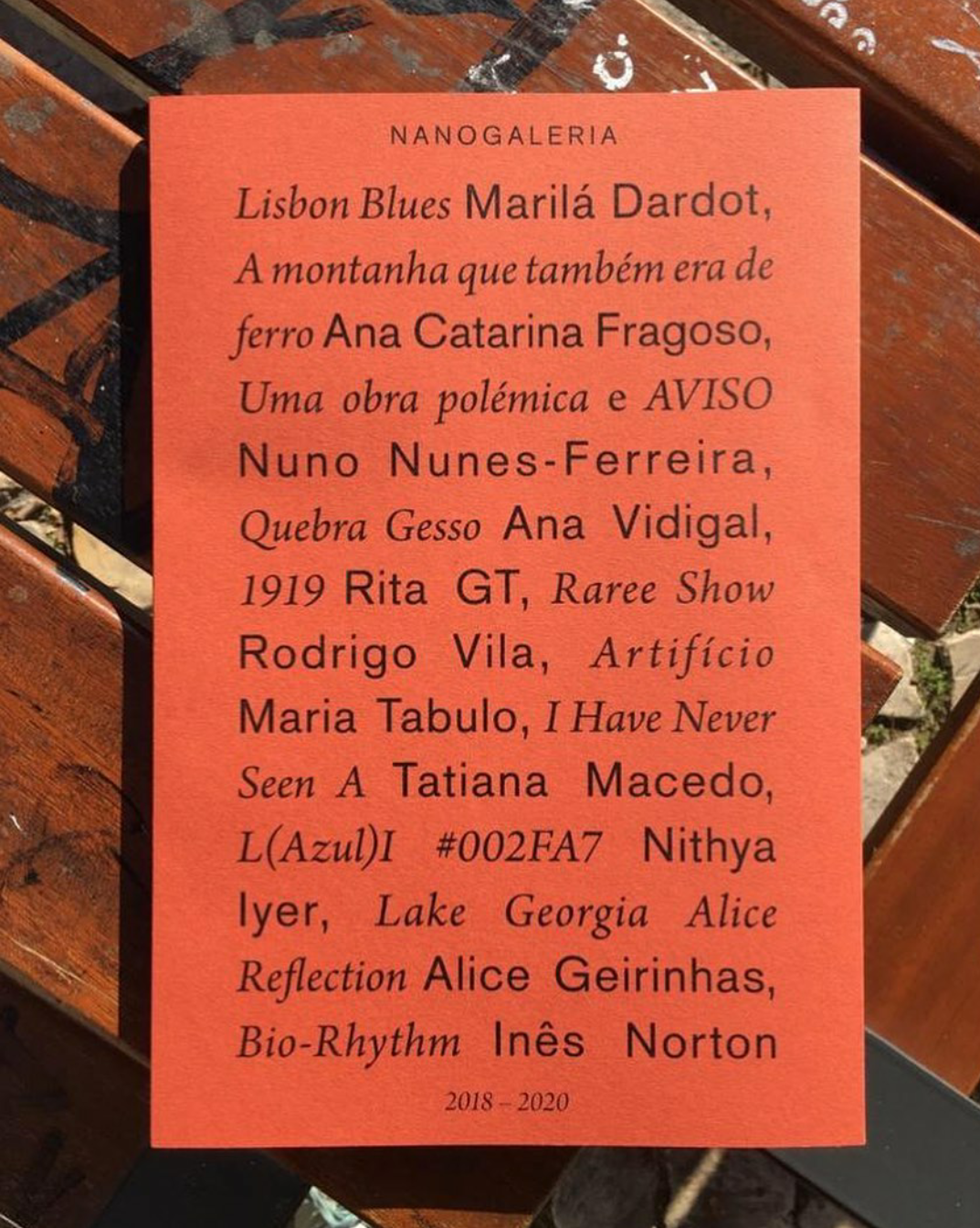
Artistic text: LAZULI #002FA7 for Nanogaleria (2020)
Publication for Nanogaleria, curated by Luisa Santos, Ana Fabiola Mauricio and Maria Duarte.
“A protolith rock is metamorphosed in heat and pressure.
In the mines of Badakhshan, Afghanistan, near the Oxus river.
A long and difficult process of removing impurities.
To Europe from traders in the Mediterranean – a name:
Beyond the Sea.2
“Blue has no dimensions, it is beyond dimensions, whereas the other colours are not.”
The Frenchman sought his dominion over the colour of his obsession patenting it in 1960:
International Klein Blue3
.
Nude women, his human paintbrushes, imprinted their bodies upon a canvas before a live orchestra.
His desire for its beauty toxic, killing him at 34.
The world deconstructing his formula to its digital: HEX #002fa7.
Portuguese artist Helena Almeida eats it.
In her 1977 work, ‘Study for Improvement’, her black and white image inhales,
consumes and wields the famous hue.
The ingestion through her mouth lauded as a feminist subversion of patriarchal hubris.
A quiet salute to the Anthropophagy Movement.”
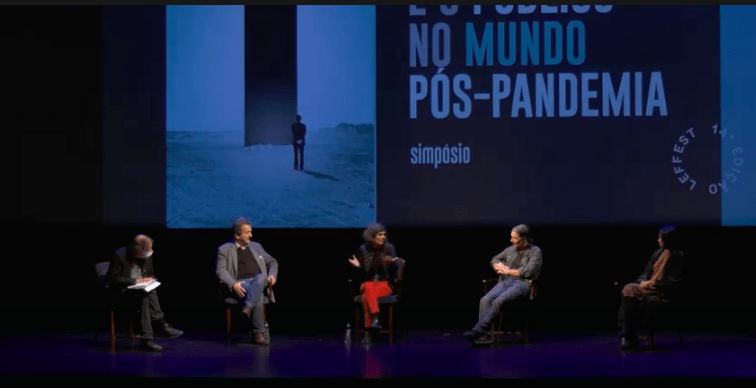
Panel: The Arts and the Public in a Post-Pandemic World, Lisbon & Sintra Film Festival (2020)
Presented at Teatro Tivoli, Lisbon, as curated by Paulo Branco, alongside Bernard Marcadé, Marie-Laure Bernadac, Neville Wakefield, and Hans-Ulrich Obrist.
Discussion presented as part of LEFF on the impact of COVID-19 on the way the arts communicated with the public.
Podcast co-host & moderation: Hangar on Art (2021 – 22)
Published by Hangar Centre for Artistic Investigation, Lisbon.
Co-hosting and moderation for talks with visiting artists and academics including: Cindy Sissokho and Fabian Villegas, Sandim Mendes, Margarida Mendes, Kiluanji Kia Henda, Pedro Barateiro, Gabriela Salgado, Edson Chagas, Deborah Willis and Claire Bishop.
Publication: Reflections and Actions on Mediation Practices [contributed chapter on Notes from Atopia] (2020)
Published by the 4Cs From Conflict to Conviviality through Creativity and Culture, funded by the European Cooperation Programme and curated by Luisa Santos, Ana Fabiola Mauricio and Maria Duarte.
“4Cs: From Conflict to Conviviality through Creativity and Culture is a European Cooperation
Project co-funded by the Creative Europe Programme of the European Union. The 4Cs seeks
to understand how training and education in art and culture can constitute powerful resources to
address the issue of conflict as well as to envision creative ways in which to deal with conflictual
phenomena, while contributing to audience development through active participation and
co-production. The project aims at advancing the conceptual framework of intercultural dialogue
and enhancing the role of public arts and cultural institutions in fostering togetherness through
cultural diversity and intercultural encounters. Coordinated by the Faculdade de Ciências
Humanas | Universidade Católica, 4Cs is grounded on the collaboration of 8 core partners (Tensta
Konsthall; SAVVY Contemporary; Royal College of Art; Fundació Antoni Tàpies; Vilnius Academy of
Arts; Museet for Samtidskunst; and ENSAD) and various local partners, such as Culture+Conflict,
MAAT, Gulbenkian Foundation, Hangar, Appleton Associação Cultural, Gaivotas 6, OR Gallery, The
Goethe-Institut, and Gasworks, among others.”
Mediation text: Notes from Atopia (2020)
Published by the 4Cs From Conflict to Conviviality through Creativity and Culture, funded by the European Cooperation Programme and curated by Luisa Santos, Ana Fabiola Mauricio and Maria Duarte.
“Notes from Atopia was an interactive three-day workshop querying the ways of altered meaning-making that emerged during the conditions of COVID19 restrictions in Lisbon in March, 2020.
Framing this period of time as one of concentrated atopos, or atopia, referring to the Greek word for ‘no place’ or ‘placelessness’, the title of the workshop alludes to the effect of the pandemic in dislocating our sense of geographical and narrative belonging. In one sense, the realities of confinement displaced
people from their places of social connection and restricted them to the interiors of their home for such an extended duration that the place of home became a non-distinct space in which all aspects of life unfolded. Compounding this phenomena was the global dysfunction and seeming threat of structural collapse ensuing from the spread of the pandemic, which cast doubt upon the reliability of social and economic systems and the integrity of dominant narratives espoused by political leaders. Atopia is
used, therefore, with regard to the existential, civilisational and ideological crises ushered in by COVID19.”
 NITHYA IYER